Local SEO Basics for Contractors: Service-Area Pages, Google Business Profile, and Website Consistency
Most contractor websites do not lose leads because of one catastrophic mistake. They lose them through a pileup of small misses. A city name is different on one page than it is on another. The phone number in Google Business Profile does not match the one in the site footer. The service pages are vague. The mobile experience feels cramped. The quote form asks for too much. A homeowner lands on the site, looks around for twenty seconds, and leaves without calling.
That is the practical side of local SEO for contractors. It is not just about ranking. It is about helping the right person, in the right service area, find enough proof and clarity to take the next step.
If you own a roofing company, HVAC shop, plumbing business, electrical company, remodeling firm, pool building company, fire protection service, or landscaping business in the U.S., local SEO usually comes down to three connected pieces. Your service-area pages need to match what you actually do and where you actually work. Your Google Business Profile needs to be complete and accurate. Your website needs to be consistent enough that Google and customers see the same business everywhere.
When those three line up, lead generation gets easier. Not automatic, not effortless, but easier.
Your website is not a brochure, especially in home services
A contractor website has a job to do. It needs to make a strong first impression, explain what you do quickly, and give visitors an obvious way to contact you. That sounds basic, but many sites still behave like digital brochures from ten years ago. They talk at length about the company, bury the phone number, and make users hunt for simple answers like whether you serve their ZIP code or handle emergency work.
Home service buyers are usually not browsing for entertainment. They have a leak, no AC, storm damage, an old electrical panel, or a backyard project they are finally ready to price. Some are on a desktop, but plenty are on a phone with one hand free. If your pages load slowly, your text is tiny, or your call button is hard to find, you are creating friction right at the moment intent is highest.
A good contractor site is built for that urgency. Fast load speed matters because people do not wait around for a giant homepage slider to finish loading. Mobile-first design matters because a large share of local service searches happen on phones. Click-to-call matters because many people would rather talk to someone than fill out a long form. Clear reviews, project photos, and service details matter because trust is often the deciding factor.
Local SEO works better when conversion basics are already in place. There is no real win in getting more traffic if the site does not turn visits into calls and quote requests.
The real purpose of a service-area page
A lot of contractors misunderstand service-area pages. They assume each nearby city deserves a page with the same content copied and the city name swapped out. That approach usually creates thin, forgettable pages that do not help users much.
A useful service-area page should answer a real question: “Can this company help me in my area, and do they understand the type of work common here?”
That does not mean you need a novel for every town. It does mean each page should feel tied to the place and the service. A page for “AC repair in Sugar Land” should not read Scalable Websites website design exactly like “AC repair in Katy” with two words changed. The neighborhoods, home ages, housing stock, commute patterns, weather impact, and common equipment issues can vary. Even a few grounded details can make the page more useful.
For many contractors, the best structure is not a page for every possible city from day one. It is a smarter mix: strong core service pages, then service-area pages for the cities or regions that matter most commercially. If you are a plumber serving fifteen towns but eighty percent of your work comes from five of them, start there.
What belongs on these pages
The page should clearly say which service is offered in that area, include the service area name naturally, and make it easy to contact you. It should also support trust. Reviews placed on the page can help. Before-and-after project galleries can help even more if the projects are relevant to that service category. For a remodeler, project photos are often the proof. For a roofer, the page might show completed roof replacements or storm restoration work. For a landscaper, a gallery can bridge the gap between “we say we do good work” and “here is what that work looks like.”
A short quote form usually performs better than a giant intake questionnaire. Name, phone, email, ZIP code, and a brief message are often enough to start. You can gather the rest once someone is engaged. Long forms may feel efficient from the business side, but they often depress lead volume.
There is also a simple organizational point many sites miss. Service pages and service-area pages are not the same thing. A service page explains what you do. A service-area page explains where you do it. The strongest local sites connect the two clearly. A visitor should be able to move from “water heater installation” to “water heater installation in The Woodlands” without getting lost.
Google Business Profile is often your real homepage
For many local searches, the first serious interaction a prospect has with your company is not on your website. It is on your Google Business Profile. They see your business name, phone number, hours, reviews, photos, and website link before they ever visit your site.
That is why profile quality matters so much for contractors. If your hours are wrong, your phone number is outdated, or your business category is too broad, you create doubt before the conversation even starts. Google also uses official web content from your website as a source for business profile and local search information, which means inconsistencies can bleed across systems.
One common problem is using a tracking number in one place, a local office number in another, and a cell number somewhere else. Call tracking can be useful, but if your core business identity becomes fragmented, both users and platforms can get mixed signals. Google has long advised using a local phone number when possible and keeping contact details accurate. For local service companies, that is practical advice, not theory.
Your profile should also point to a landing page that supports action. If the profile sends people to a generic homepage with no immediate relevance to their search, you force them to start over. If someone searched “panel upgrade electrician near me,” they should not have to dig through five menu layers after clicking your site. A relevant service page or local landing page makes the handoff smoother.
The profile and the site should back each other up
Think of Google Business Profile and your website as two halves of the same storefront. The profile earns the click or call. The website answers the follow-up questions. If one says you are open Saturdays and the other says you are closed, trust drops. If the profile says one area and the site suggests another, people hesitate. If your services are unclear on the site, your profile alone cannot carry the sale.
That is why consistency matters more than most contractors realize. Not because consistency is glamorous, but because confusion is expensive.
Website consistency is not busywork
Contractors often hear the phrase “NAP consistency,” meaning name, address, and phone number consistency. That still matters, but for home service businesses, consistency goes wider than that.
Your hours should match. Your service descriptions should not conflict. Your listed service areas should be current. If you recently stopped serving one county and expanded into another, update every place where that information appears. Your footer, contact page, Google Business Profile, and area pages should tell the same story.
This is especially important for service-area businesses that do not rely on a walk-in office. If customers cannot physically visit you, then accurate digital information becomes even more important. They are evaluating reliability from what they can verify online.
A simple example: say a fire protection contractor serves commercial clients across a metro area but has a website that only mentions one city on the homepage, three different cities on service pages, and a Google Business Profile that does not clearly reflect the service region. A building manager trying to confirm coverage may move on simply because the footprint is hard to understand.
The fix is not fancy. It is disciplined editing.
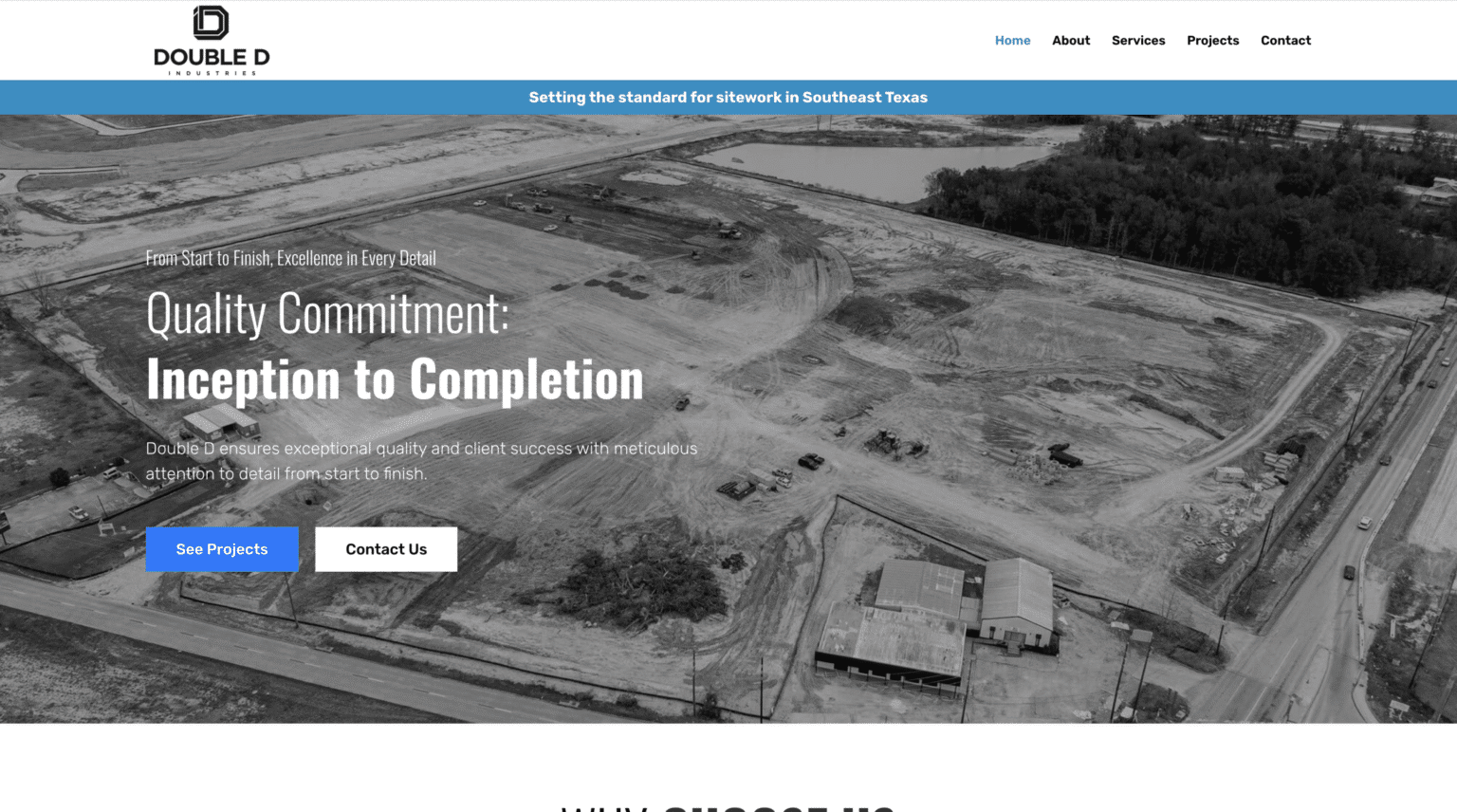
The local SEO issues I see most often on contractor sites
These are the mistakes that come up again and again, whether the business is doing roofing, plumbing, pool construction, or landscaping.
- The homepage tries to rank for everything and explain everything at once. It ends up saying very little clearly.
- Service pages are thin, generic, or merged together even when the business offers distinct categories of work.
- City pages are duplicated with token word changes, which creates weak pages for both users and search engines.
- The mobile experience is clunky, with tiny buttons, slow pages, and forms that are annoying to complete on a phone.
- Contact paths are weak. No obvious tap-to-call option, no missed-call text-back, no live chat or smart chat option, and no clear next step.
That fifth issue is bigger than it sounds. A lot of contractors work in the field all day and miss calls. It happens. If your business cannot pick up every time, missed-call text-back can save opportunities that would otherwise disappear. The same goes for website chat, including modern chat tools that can answer basic questions, collect lead details, and route inquiries after hours. Those tools are not a replacement for a good office process, but they can plug obvious holes.
Reviews, photos, and proof beat vague claims
Most contractor websites say some version of “quality work” and “great service.” Customers have seen those words a thousand times. They carry very little weight on their own.
What helps more is proof placed where it supports decision-making. Reviews embedded on the site can reinforce trust, especially on service pages and quote pages. Project galleries do the same thing visually. For trades where the result is visible, such as roofing, remodeling, pool building, and landscaping, before-and-after photos often do more than three paragraphs of marketing copy.
Even for less visual trades like electrical or HVAC, photos still matter. Clean installs, organized crews, finished equipment setups, panel upgrades, and branded trucks help people feel like they are dealing with a legitimate operation.
There is a judgment call here. Do not overload every page with giant image galleries that slow the site down. Fast load speed still matters. Use compressed images, choose a manageable number of strong photos, and keep the page focused on moving the visitor toward a call or form submission.
Mobile-first is not optional for local service leads
A contractor site that looks decent on a desktop but feels frustrating on a phone is underperforming. This is one of the clearest gaps I see between websites that merely exist and websites that actually generate leads.
The best mobile-first contractor sites make a few things obvious right away. The service categories are easy to tap. The phone number is prominent. There is a simple quote button. The text is readable without zooming. The page does not jump around while assets load. Trust signals appear early, not buried at the bottom.
Google has highlighted the importance of robust mobile experiences and timely human-assisted contact in high-intent moments. That fits home services perfectly. If someone needs an emergency plumber at 8:30 p.m., they are not looking for a polished essay. They want reassurance and a clear path to help.
This is where click-to-call still earns its keep. A phone number at the top of the screen, tied to a tap-to-call function, removes friction. It sounds obvious, but many contractor sites either hide the number or place it in a way that is not easily usable on a phone.
How to tighten up your local pages without overbuilding them
Many businesses swing between two bad extremes. One is having no dedicated local pages at all. The other is creating dozens of weak pages that nobody maintains.
The better path is selective coverage. Build pages where there is real demand, real service capacity, and enough business value to justify a page. Then make those pages useful.
A strong page does not need gimmicks. It needs clear service alignment, area relevance, and a clean conversion path. If you are an electrician serving Houston, Pasadena, Pearland, and League City, your pages should reflect actual operations. Do not create pages for cities you rarely serve just because they are nearby. That can frustrate users and create operational headaches when leads come from places your team does not really want to go.
It also helps to keep local claims specific but honest. You do not need made-up local statistics or fake neighborhood stories. A few grounded references, actual project photos where appropriate, and a direct explanation of the service in that area are enough.
Choosing who should build and maintain the site
This is where many owners get stuck. They know the current site is weak, but they are unsure whether to DIY it, hire a freelancer, sign with an agency, or use a managed subscription service.
Each option has trade-offs. DIY builders can work for very small operators who have time, patience, and a decent eye for layout, but they often produce sites that look acceptable while missing deeper conversion and local SEO fundamentals. Freelancers can be excellent if you find a strong one who understands contractor websites, though availability and long-term maintenance are common pain points. Agencies may bring more strategy and process, but cost and speed can vary widely. Managed website subscriptions can make sense for owners who want predictable monthly support, updates, hosting, security, and someone accountable for changes.
Here is the honest comparison in plain terms:
| Option | Usually best for | Common upside | Common downside | |---|---|---|---| | DIY builder | Very small shops, early stage operators | Low initial cash outlay, full control | Time drain, weaker strategy, easy to overlook mobile and local SEO basics | | Freelancer | Owners who want custom help without a full agency | Flexible, can be cost-effective | Quality varies, support can disappear, updates may be slow | | Agency | Established companies with bigger goals | Broader expertise, stronger process | Higher cost, sometimes slower or more layered communication | | Managed subscription | Owners who want ongoing support and predictable maintenance | Hosting, security, updates, and support are often bundled | Less ideal if you want to tinker constantly on your own |
There is no universal winner. The right choice depends on budget, urgency, internal bandwidth, and how involved you want to be. A Houston company like Scalable Websites is one example of the managed subscription model for home service contractors, with design, hosting, security, unlimited updates, and a dedicated project manager included. For some owners, that kind of arrangement is easier to live with than a large rebuild followed by silence. For others, a trusted freelancer is enough. The mistake is assuming the build choice matters more than the ongoing discipline of keeping the site accurate and useful.
A practical cleanup plan for the next 30 days
If your local SEO foundation feels messy, do not try to rebuild everything at once. Start with the pages and data that most directly affect leads.
- Audit your core business details across the site and Google Business Profile, especially company name, phone number, hours, and service area wording.
- Rewrite your top service pages so each one clearly explains the work, includes an obvious call to action, and supports mobile visitors.
- Build or improve service-area pages for the cities that actually drive business, using unique copy and relevant examples.
- Tighten conversions by adding click-to-call, shortening quote forms, and setting up missed-call text-back if your team misses calls.
- Add proof where it matters most, including reviews on key pages and project photos that support the service being discussed.
That is enough to create momentum. You can always expand later.
The quiet advantage of getting the basics right
Contractors sometimes chase advanced tactics before the foundation is stable. They want more traffic, more pages, more tools, more automation. Sometimes that is appropriate. Often it is not the next best move.
The quieter advantage comes from getting the basics right and keeping them right. A clean mobile experience. A homepage that explains the value proposition quickly. Service pages that match what you actually sell. Area pages that reflect where you really work. A Google Business Profile that is accurate. Reviews and project photos in the right places. A contact flow built for real people who may need to call right now.
That work is not flashy, but it compounds. It helps search visibility, yes, but it also helps conversion once people arrive. And for contractors, that is the whole point. A website should not just sit there and look respectable. It should help turn local searches into booked estimates, service calls, and conversations with the right prospects.
If your site is inconsistent, the good news is that most of the fixes are straightforward. They require attention more than magic. And in local service marketing, attention to the unglamorous details often beats big promises every time.
About Scalable Websites
Scalable Websites builds professionally designed, AI-powered websites for roofers, HVAC companies, plumbers, electricians, remodelers and other home service contractors, with hosting, security, unlimited updates and lead capture included in one monthly plan.
396 Mallorn Lane, Montgomery, TX 77316
Phone: (832) 979-2478
Website: scalablewebsites.com
About Scalable Websites
Scalable Websites builds professionally designed, AI-powered websites for roofers, HVAC companies, plumbers, electricians, remodelers and other home service contractors, with hosting, security, unlimited updates and lead capture included in one monthly plan.
Houston, TX · Serving contractors nationwide
Phone: (832) 979-2478
Website: scalablewebsites.com